Bearded dragons come from hot, dry inland Australia, so it is easy to assume Bahrain suits them perfectly. But a dragon kept indoors lives in whatever conditions its enclosure provides, and those change more through the year than many owners realise.
In summer, air conditioning running day and night can leave a tank colder than expected. In the cooler months, the AC goes off, windows open and rooms can get much colder at night. Many adult dragons also naturally slow down at this time of year. This guide explains what is normal, what is a sign of illness, and when to call a vet.
Getting heat right as the weather cools
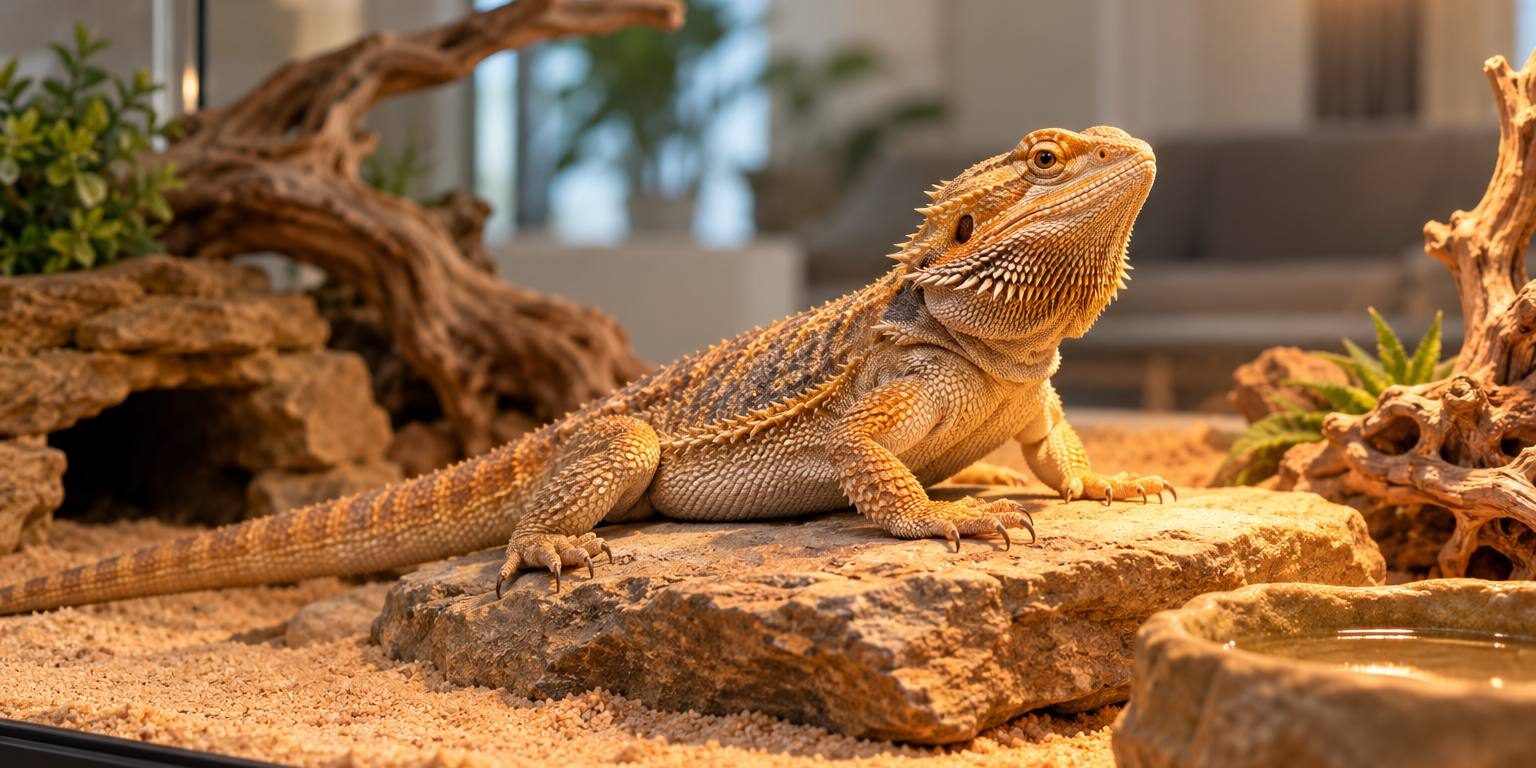
Reptiles cannot make their own body heat. Your dragon relies on its enclosure to warm up enough to move, digest food and fight infection. What it needs is a temperature gradient: a hot basking spot at one end and a cooler area at the other, so it can move between them to control its own temperature.
As a general guide, an adult dragon needs a basking spot of roughly 38 to 42°C, with the cool end in the mid to high 20s. Night-time temperatures can safely fall lower, but not by a large amount. Young dragons often need slightly different conditions. Your vet can confirm the right range for your dragon’s age and setup.
Practical checks for the cooler months
- Measure, do not guess. Stick-on dial thermometers are often inaccurate. A digital thermometer with a probe, or an infrared temperature gun pointed at the basking surface, gives you real numbers.
- Check at night, not just in the day. Take a reading late in the evening on a cool night with the windows open. This is when Bahrain homes are coldest, and when problems usually start.
- Use a thermostat. Heat sources should be controlled by a thermostat so the enclosure cannot overheat during the day or get too cold at night.
- Avoid heat rocks and unguarded bulbs. Dragons can burn themselves on hot surfaces without moving away in time. Lamps should be guarded and placed so your dragon cannot touch them.
- Think about where the tank sits. Near a window it may get cold draughts in winter and overheat in direct sun at other times of year. Next to an AC vent, it may be chilled all summer.
UVB lighting: the part owners most often get wrong
Bearded dragons need UVB light to make vitamin D3, which they use to absorb calcium from their food. Without enough UVB, they can develop metabolic bone disease, a serious condition that weakens bones and can cause deformity, fractures and tremors.
A few points are worth knowing:
- UVB does not pass through ordinary window glass or plastic. A tank on a sunny windowsill is not getting useful UVB, and in Bahrain it can overheat quickly.
- UVB bulbs and tubes lose strength over time while still looking bright. Replace them in line with the manufacturer’s guidance rather than waiting until they stop working.
- The lamp needs to be at the correct distance from the basking spot, without a glass or plastic cover in between. Some mesh lids also reduce UVB, so check the product guidance.
- The cooler months are a good time for short, supervised sunbathing outdoors in natural sunlight. Use a secure, well-ventilated enclosure with shade available. Never use a glass tank for this, as it can overheat in minutes, and stay with your dragon the whole time.
Brumation: the winter slowdown
Many adult bearded dragons go through brumation in the cooler months. It is a natural period of reduced activity, a little like a light hibernation. It can happen even in indoor enclosures, because dragons respond to small changes in day length and temperature.
A brumating dragon may:
- sleep much more and stay at the cool end or hide
- eat very little or stop eating altogether
- bask less often and for shorter periods
- still drink occasionally and keep a steady body weight
Why a vet check comes first
A sick dragon can look exactly like a brumating one. Parasites, infections, metabolic bone disease, gut impaction and egg problems in females can all cause lethargy and loss of appetite. If you assume it is brumation, an illness can go untreated for weeks.
Before your dragon settles into a quiet winter, book a check-up. Your vet will usually check its weight and body condition and may suggest testing a faecal sample for parasites. A dragon that brumates with parasites or low body reserves is more likely to have problems coming out of it.
Young dragons that are still growing should not normally brumate. If a juvenile suddenly becomes sleepy and stops eating, treat it as a reason to see a vet.
Caring for a dragon during brumation
- Weigh your dragon weekly on a kitchen scale and write the number down. Gradual, small changes may be normal, but steady or obvious weight loss is not and needs a vet.
- Keep fresh water available.
- Do not force-feed or keep offering large meals. Food needs warmth to digest properly, and a cool, inactive dragon with a full gut can develop problems.
- Keep the setup safe, even if your dragon is barely moving. Ask your vet how to manage heat and lighting during this period rather than switching everything off.
When to contact a vet
Reptiles hide illness well, so by the time signs are obvious, a problem may already be advanced. Contact your vet promptly if your dragon has:
- loss of appetite or weight loss, and no vet has confirmed that it is brumating
- twitching, tremors, a soft or swollen jaw, or swollen legs
- difficulty walking, standing or lifting its body
- breathing with its mouth open, wheezing, or bubbles or mucus around the mouth or nose
- runny, bloody or very smelly droppings, or no droppings for a long period while eating
- in females, restless digging, a swollen belly or straining without laying eggs (females can produce eggs without a male)
- burns, injuries, or tissue protruding from the vent
Sudden collapse, severe breathing difficulty or a heavy, straining female needs to be seen urgently.
Getting your dragon to the vet in cooler weather
Warm the car first and use a secure, ventilated carrier lined with a towel. A wrapped hot water bottle placed under part of the towel, not in direct contact with your dragon, can help keep it warm on the way. If travel is very stressful for your pet, our team also offers home visits.
Frequently asked questions
My bearded dragon has stopped eating. Is it brumating?
It might be, especially in an adult during the cooler months. But illness can look the same, so have your dragon checked before assuming it is brumation. Weighing it weekly helps you and your vet see whether it is holding its condition.
How long does brumation last?
It varies between individuals. Some dragons slow down for a few weeks, others for longer, and some barely brumate at all. Your vet can advise what is reasonable for your dragon and what changes should prompt a check.
Can I keep my bearded dragon’s tank in an air-conditioned room?
Yes, many dragons in Bahrain live in air-conditioned homes. The key is to measure temperatures inside the enclosure, particularly at the cool end and at night, and to keep the tank away from direct AC airflow.
What should my adult dragon eat?
Adults need mostly leafy greens and vegetables, with insects as a smaller part of the diet, while young dragons eat far more insects. Insects are usually dusted with a reptile calcium supplement, and never feed wild-caught insects. Ask your vet for advice suited to your dragon’s age and setup.
Book a check-up for your bearded dragon
Charis Vets in Budaiya cares for birds and exotic pets, including reptiles, and can advise on diet, housing, temperature and lighting. You can see everything we offer on our services page. If you also keep birds, our guide to pet bird care in the cooler months may help. Call us on 13106800, message us on WhatsApp at 33620201, or book an appointment online.