Dachshunds are bold, funny and fiercely loyal, and they are a popular breed in Bahrain homes. They also have one well-known weak spot: their back. Their long spine and short legs make them far more prone than most dogs to a painful condition called intervertebral disc disease (IVDD).
The good news is that owners can do a lot to lower the risk, and knowing the early warning signs makes a real difference to how well a dachshund recovers if something does go wrong. This guide covers both, plus what to look for in a vet for your dachshund.
Why dachshunds are prone to back problems
Between each bone of the spine sits a disc that works like a small shock absorber. In dachshunds and other short-legged breeds, these discs tend to age early. They can harden and lose their cushioning while the dog is still young, often between about three and seven years of age.
A hardened disc can bulge or burst into the spinal canal and press on the spinal cord. Depending on how much pressure there is, the result can range from back pain to wobbly legs or, in severe cases, paralysis. It can follow a jump or twist, or happen on a quiet day at home, because the disc was already weakened.
Genetics play a large part, so you cannot prevent every case. What you can do is reduce the everyday strain on your dog’s back and act quickly if signs appear.
Everyday habits that protect your dachshund’s back
Keep them lean
Extra weight puts extra load on a long spine. You should be able to feel your dachshund’s ribs easily under a thin layer of fat, and see a waist from above. Many Bahrain dogs gain weight over the summer, when walks are short and indoor treats are plentiful. If your dog has filled out, ask your vet for a target weight and a realistic feeding plan rather than cutting food drastically.
Cut down on jumping
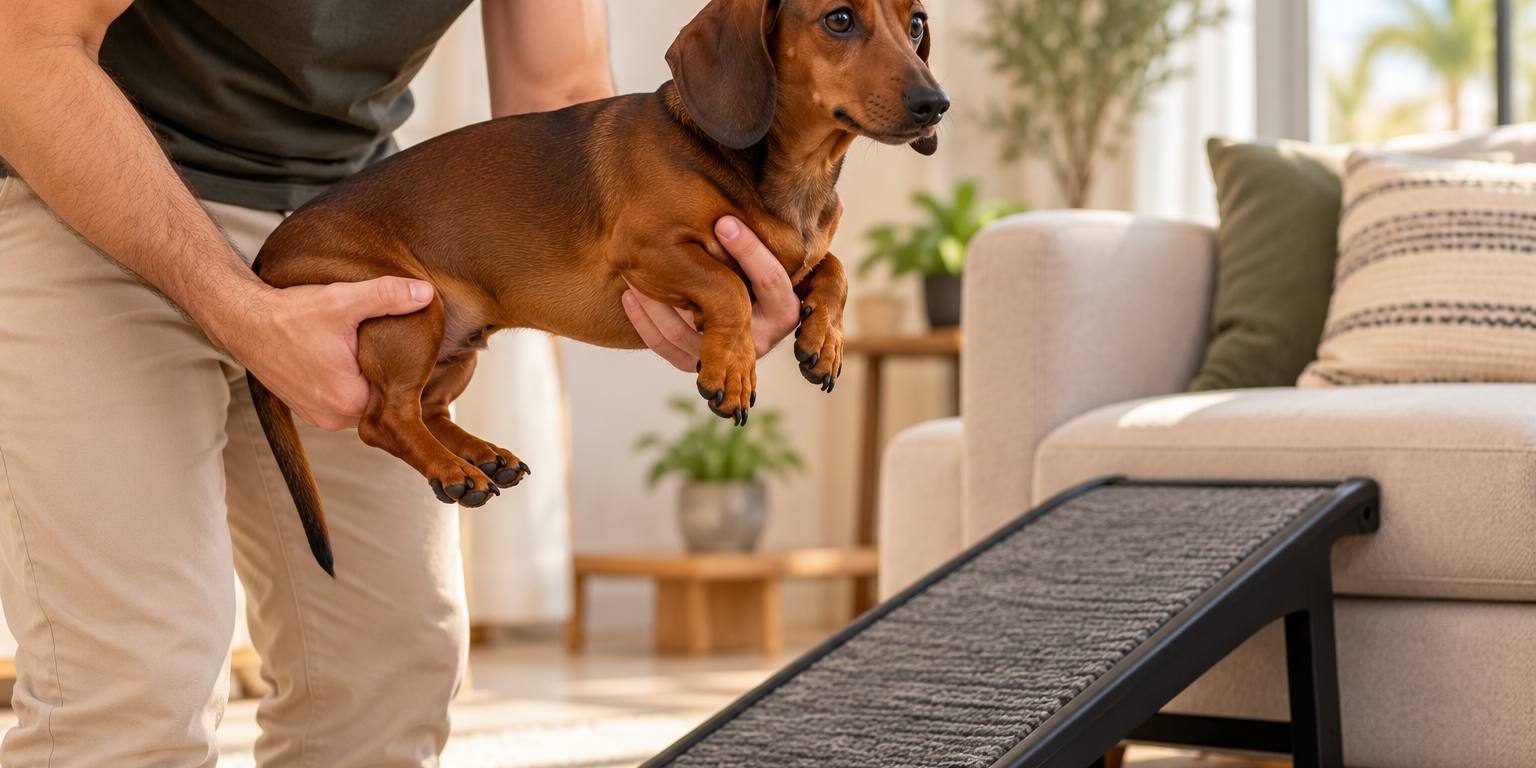
- Use ramps or pet steps for the sofa and bed, or keep your dog off high furniture altogether.
- Lift your dachshund with one hand under the chest and the other supporting the back end, keeping the spine level. Avoid picking them up under the front legs only.
- Limit long flights of stairs where you can. In apartment buildings, the lift is the kinder option.
Make floors less slippery
Tiled and marble floors are common in Bahrain villas and flats, and they are slippery for short legs. Rugs or runners along your dog’s usual routes, especially at the bottom of stairs and around food bowls, help them keep their footing. Keep nails trimmed and the fur between the paw pads tidy for better grip.
Choose a harness over a collar
A well-fitted harness spreads pressure across the chest instead of the neck. This matters most for dogs that pull on the lead.
Build fitness gradually as the weather cools
Strong core and back muscles support the spine. Regular, moderate walks are better than occasional bursts of hard play. With cooler mornings and evenings arriving in Bahrain, this is a good time to build walks back up after the summer, increasing distance slowly rather than going straight to long outings. Ball chasing with sharp turns and leaps is best kept short.
Warning signs to watch for
Dachshunds are stoic and early back pain is easy to miss. Watch for:
- Reluctance to jump up, climb stairs or go for a walk
- A hunched back, a tense tummy or a stiff, careful way of moving
- Yelping when picked up or touched along the back or neck
- Shivering or trembling when it is not cold
- Not wanting to lower the head to eat or drink (a sign of neck pain)
- Wobbly back legs, crossing or scuffing the hind feet, or knuckling over onto the tops of the paws
- Dragging one or both back legs
- Accidents indoors, or difficulty passing urine
What to do if you notice signs
Back pain alone: call your vet the same day. Even if your dog is still walking, pain can be the first stage of a disc problem that gets worse.
Weakness, wobbliness, dragging legs or loss of bladder control: treat this as an emergency and contact a vet straight away. With severe spinal cord compression, the sooner your dog is assessed, the better the chances of recovery.
While you arrange care:
- Keep your dog confined to a crate or a small, quiet space so they cannot run, jump or use stairs.
- Carry them with the spine kept level and well supported.
- Do not give human painkillers. Several common ones are dangerous for dogs.
- Do not wait to see whether they “walk it off”. Rest without a diagnosis can mean losing valuable time.
How vets diagnose and treat IVDD
Your vet will start with a careful neurological examination, checking walking, reflexes and sensation in the legs, to work out where in the spine the problem is and how serious it is. X-rays help rule out other causes, and advanced imaging is often needed to see exactly which disc is involved, especially if surgery is being considered.
Treatment depends on the severity:
- Milder cases are often managed with strict rest in a crate for several weeks, pain relief and anti-inflammatory medication prescribed by the vet, and close monitoring. Strict rest is hard for a lively dachshund, but it gives the disc time to stabilise.
- Severe or worsening cases, such as dogs that cannot walk, may need spinal surgery to remove the disc material pressing on the cord.
- Rehabilitation, including controlled exercise and hydrotherapy, helps many dogs rebuild strength and coordination after either approach. Your vet will tell you when it is safe to start.
Recovery can take weeks to months, and every case is different. At Charis Vets in Budaiya, our services include orthopaedic and neurosurgery, AI-assisted X-rays and hydrotherapy for dogs recovering from spinal injury.
Other health points for dachshunds
- Teeth: small jaws mean crowded teeth, and many dachshunds build up tartar early. Regular dental checks and home tooth brushing help.
- Heat: being low to the ground, dachshunds are close to hot pavements and sand. In warmer months, walk early in the morning or after sunset and test the ground with the back of your hand.
- Regular check-ups: an annual wellness exam is a chance to check weight, teeth and spinal comfort before small issues become big ones.
Choosing a vet for your dachshund
Because back problems can become urgent quickly, it helps to choose a vet before you need one. Useful questions to ask include whether the clinic has imaging on site, whether spinal surgery is available or how referrals are handled, whether rehabilitation such as hydrotherapy is offered, and how to reach the team in an emergency. Save the number in your phone so you are not searching for it at a stressful moment. Our guide to caring for your pet during emergencies in Bahrain has more general advice.
Frequently asked questions
Can a dachshund recover from IVDD without surgery?
Many dogs with milder signs do recover with strict rest and medication. Dogs that cannot walk, or whose signs keep getting worse, often need surgery for the best chance of recovery. Your vet will advise based on the examination.
Is crate rest really necessary?
Yes, if your vet recommends it. Even a few minutes of running or jumping can undo progress. Most dogs settle better than owners expect, especially with company nearby and gentle activities such as food puzzles.
Can IVDD come back?
It can. A dog that has had one disc problem may have another, because other discs may have aged in the same way. Keeping your dog lean, using ramps and avoiding jumping remain important for life.
Book a check-up
If your dachshund is showing any of the signs above, or you would like advice on weight, exercise or back care, we are here to help. Book an appointment online, call us on 13106800 or message us on WhatsApp at 33620201. If your dog cannot walk or seems to be in severe pain, please call us straight away.
Reviewed by Dr. Melvin Varghese Jacob, BVSc & AH, MVSc, F.VMAS, General, Ophthalmic & Laparoscopic Surgeon at Charis Vets. Meet our vets