A torn cruciate ligament is one of the most common reasons a dog starts limping on a back leg. For many owners it is also the first time they hear the word “cruciate”, usually alongside the word “surgery”. This guide explains what the ligament does, how the injury is diagnosed, what the treatment options are, and what recovery at home really involves, so you can make the decision with your vet with a clear picture of what lies ahead.
What is the cruciate ligament?
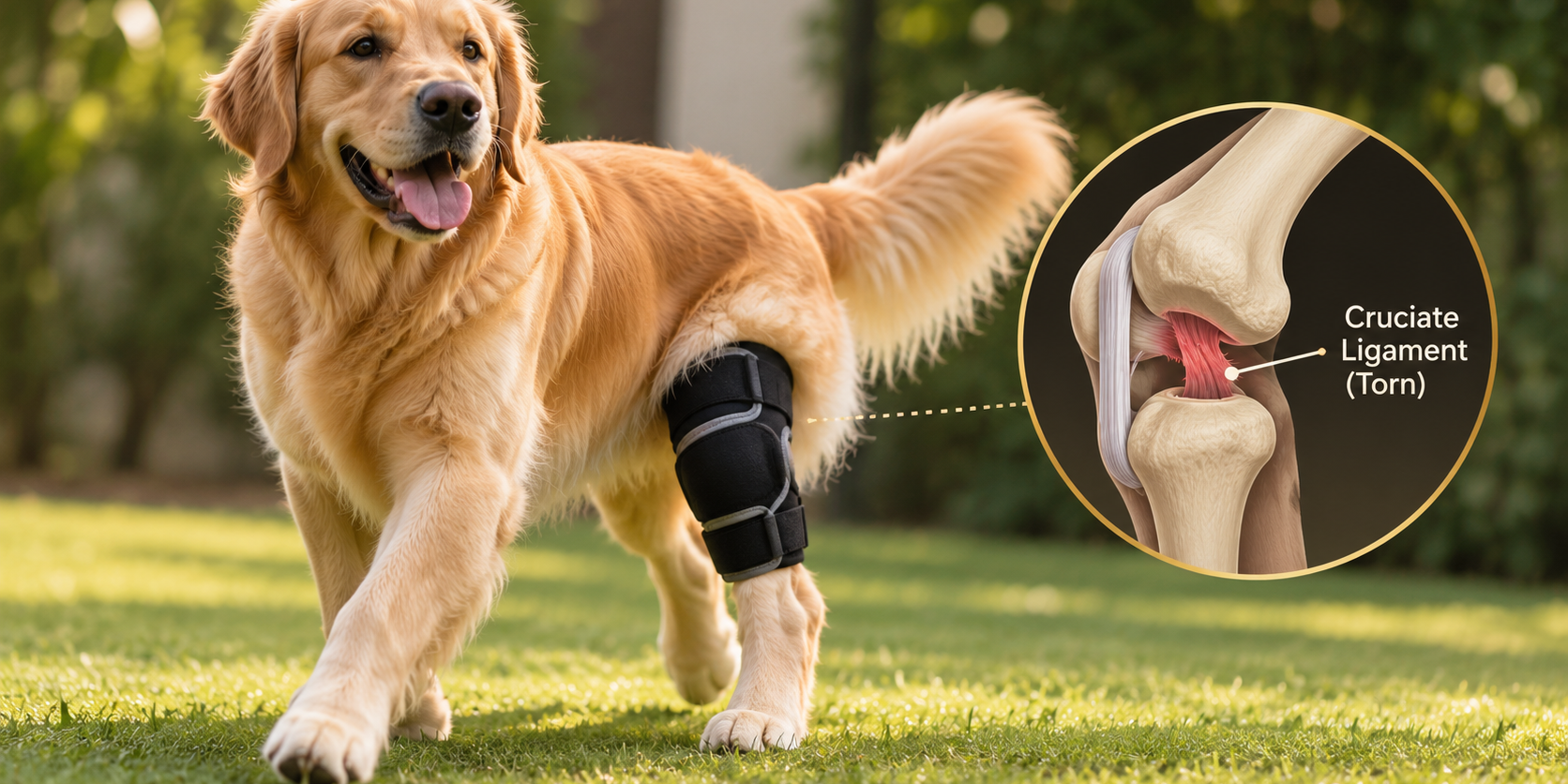
Inside each knee (the stifle) are two ligaments that cross over each other. The one that matters here is the cranial cruciate ligament, the dog’s equivalent of the ACL in people. Its job is to stop the shin bone sliding forwards under the thigh bone each time the dog puts weight on the leg.
When the ligament tears, partly or fully, the knee becomes unstable. Every step lets the bones shift slightly, which is painful, inflames the joint and, over time, leads to arthritis. The cartilage cushions inside the knee (the menisci) can also be damaged by the abnormal movement.
Why it happens
In people, an ACL tear is usually a sports injury. In dogs it is more often the end point of gradual weakening of the ligament over months or years, so a tear can happen during an ordinary moment, such as jumping off the sofa or turning quickly in the garden. Being overweight, being a larger or very active breed, and age all add strain. This is also why a dog that has torn the ligament in one knee has a higher chance of developing the same problem in the other knee later on.
Cats can injure the cruciate ligament too, but it is much less common and usually follows a fall or other trauma.
Signs to look out for
The signs can be sudden or creep in slowly:
- A back-leg limp that appears suddenly, sometimes with the dog barely touching the toes to the ground
- A limp that improves with rest and then returns after exercise
- Stiffness when getting up after lying down
- Sitting with one back leg pushed out to the side rather than tucked neatly underneath
- Reluctance to jump into the car, climb stairs or go for walks
- A firm swelling on the inner side of the knee in longer-standing cases
- A clicking sound from the knee when walking, which can suggest the meniscus has also been damaged
A partial tear can cause a mild, on-off limp for weeks before the ligament fails completely. If your dog’s limp lasts more than a day or two, or your dog will not put weight on the leg at all, book a check rather than waiting to see if it settles.
How the injury is diagnosed
Your vet will start by watching your dog walk and then feel the knee carefully. Specific tests check whether the shin bone slides forwards when it should not. These are not always easy to perform on a tense, muscular dog, so sedation is sometimes needed for an accurate result.
X-rays cannot show the ligament itself, but they show fluid in the joint, early arthritis, and other causes of lameness such as bone problems. Where the picture is unclear, or to plan surgery precisely, advanced imaging such as a CT scan can help. Charis Vets offers orthopaedic surgery and full body CT scanning for pets in Bahrain, and no referral is needed for an initial assessment.
Treatment options
Surgery
For most medium and large dogs, and for active dogs of any size, surgery is generally recommended because it gives the best chance of a stable, comfortable knee. There are several recognised techniques. Broadly, they fall into two groups:
- Procedures that change the shape of the knee. The surgeon cuts and repositions part of the shin bone so that the knee stays stable without needing the ligament. These are commonly chosen for larger and more active dogs.
- Procedures that stabilise the knee from the outside. A strong implant placed outside the joint takes over the ligament’s role while scar tissue forms. These are more often considered for smaller, lighter dogs.
In both cases the surgeon also checks the menisci and treats any damage. The right choice depends on your dog’s size, age, activity level, the shape of the knee and the surgeon’s experience. It is worth asking your vet why they recommend a particular technique for your dog and what recovery it involves.
Managing without surgery
Some small dogs, cats and dogs who are not well enough for an anaesthetic can be managed without surgery. This means strict rest followed by a slow return to activity, careful weight control, pain relief prescribed by your vet, and often a structured rehabilitation programme. Recovery tends to be slower, and the knee is more likely to develop arthritis, so this route works best with honest, regular check-ups to make sure your dog is comfortable.
Recovery at home after cruciate surgery
Surgery is only half the treatment. The weeks afterwards decide much of the outcome, and they ask a lot of owners. Your surgeon will give you a plan for your dog, but most recoveries share the same shape.
The first two weeks
- Keep your dog confined to a small room or a large crate when you cannot supervise.
- Toilet trips on a short lead only, with no running, jumping or playing.
- Keep the cone or protective garment on so the wound is not licked.
- Check the wound daily for redness, swelling or discharge.
- Give any medication exactly as prescribed, and never give human painkillers, which can be dangerous for dogs.
Weeks two to eight and beyond
Lead walks usually build up gradually, a few minutes at a time, as advised by your surgeon. Many dogs have a follow-up examination, and after bone-reshaping procedures, X-rays to confirm healing. Full return to normal exercise typically takes several months. The hardest part is often that dogs feel well long before the knee is ready, so the restrictions need to stay in place even when your dog is asking to play.
Once your surgeon is happy with healing, controlled rehabilitation, including hydrotherapy, can help rebuild muscle and movement safely. Ask your vet when your dog is ready.
Practical tips for Bahrain homes
- Cover slippery floors. Tiled and marble floors are common here and are a real hazard for a healing knee. Lay rugs or yoga mats along the routes your dog uses most.
- Block stairs and sofas. Use baby gates and keep your dog off furniture until your vet says otherwise.
- Plan walks around the heat. Even in the cooler months, midday pavements can be hot. Early morning and evening are best for short lead walks, and in summer the extra care is essential.
- Keep the weight off. A recovering dog burns fewer calories. Ask your vet how much to feed during rest, as extra weight puts more strain on both knees.
When to contact your vet
Whether or not your dog has had surgery, call your vet promptly if you notice:
- Your dog suddenly stops using a leg that had been improving
- Swelling, heat, discharge or an open wound at the surgery site
- Your dog seems quiet, off food or in more pain than expected
- Limping starts in the other back leg
If your dog is in severe pain or cannot stand, treat it as urgent. Our guide to emergency vet care in Bahrain explains what to do.
Frequently asked questions
Can a torn cruciate ligament heal on its own?
The ligament itself does not heal back together. Scar tissue can make the knee more stable over time, which is why some small dogs cope without surgery, but larger dogs usually remain unstable and sore without treatment.
Is my dog too old for cruciate surgery?
Age alone is not usually the deciding factor. Your vet will look at your dog’s overall health and anaesthetic risk, and pre-anaesthetic blood tests help with that decision.
Will my dog tear the other knee?
It is a real risk, because the underlying weakening often affects both knees. Keeping your dog lean and fit is the best thing you can do to reduce the strain.
How soon after the injury should surgery happen?
There is rarely a need for same-day surgery, but waiting many weeks lets arthritis and meniscal damage progress. Get an assessment early so you have time to plan.
Worried about your dog’s knee?
If your dog is limping on a back leg, our team in Budaiya can examine the knee, arrange imaging and talk you through the options. Larger breeds are especially prone to joint problems, and our guide to large dog care in Bahrain covers early warning signs. Call us on 13106800, message us on WhatsApp at 33620201, or book an appointment online.
Reviewed by Dr. Hansel Geo Thomas, BVSc & AH, MS (UK), F.VMAS, Founder and Specialist Laparoscopy & Gynaecology Surgeon at Charis Vets. Meet our vets